Life isn't fair.
That's what they say, life isn't fair. Is that really true? Is life not fair to any of us? Or is it just that we all look upon the things that we would prefer not to have happened as being unfair?
I don't actually have a job at the moment, my life consists of sending out my CV to various newspapers and magazines and hoping that one of them gets back to me. I spend the rest of my time watching TV, reading up on the news and sport, and eating. At first that sounds like a fantastic life, but after about four hours its too little for me.
For a background to this story I've just finished a journalism course and am now trying to get myself into one of the most competitive industries there is. A few of my friends have managed to find jobs, they're good, they deserve them. At times the fact that I'm sat here doing nothing starts to feel a little unfair. But is it really?
I got a text earlier off a friend about an interview he'd just had. I'll admit that as well as feeling happy for him a small part of me was annoyed that I've not had such an experience yet. I've passed some exams that he hasn't, surely I should be there first?
Grumpiness goes hand in hand with boredom. Of course I shouldn't have that chance, he went for it, he's got it. I'm pretty sure I didn't apply for that job, I'm also pretty sure that he's just as good at what we do as I am. In terms of reporting news he's probably better. So why do I feel annoyed?
Because life's not fair. That's what some people would say to me.
I'm going to take this space to declare that I'm not going to use that excuse, not today, not tomorrow, not ever. I've had chances other people haven't had, I'll get chances others don't in the future. If someone else has gone out and got something why does that mean that life isn't fair for me?
That's a problems with the world sometimes. A sense of entitlement slips into peoples minds, a sense that things should be there for them. Well they aren't, and just because they aren't doesn't mean that life is being unfair to you. There are people out their who suffer every day of their lives, they have no food, they scavenge for whatever they can get and I bet they complain less than you do if you didn't get a chance someone else got.
So be happy, life isn't being unfair to you, it's being life. You live it, you're blessed to have a life and if you're privileged enough to be able to use the internet and therefore read this you've got a pretty blessed life indeed.
Life is fair, it just happens to be different dependent on your circumstances.
Monday, 13 December 2010

Tuesday, 3 August 2010
Thoughts on a mid life crisis
As a Damon Hill fan, and a Williams fan to boot, I’m going to try and write this as objectively as I can, but forgive me if from time to time I go a little far with my condemnation.
Despite my personal favouritism I was as excited as anyone to see Michael Schumacher return to the sport at the start of the season.
I watched Michael dominate F1 for the best part of a decade, no matter what you thought of him you’d have to be the most biased person in the world not to admit that he was the best out there. No one could touch him and, even though the car was undoubtedly better than the rest, at times he did things that left you open mouthed.
Michael was so good that after 2004 F1 changed its own rules to reduce the advantage that a win gave to try and rein him in.
If you don’t know the story, or don’t remember, the elder of the Schumacher brothers won 12 of the first 13 races of that season, winning the championship with an unprecedented 4 races left.
Now he’s back - and with him came a whirlwind of excitement and media coverage. Unfortunately what also returned was the dark side of his career.
Michael may have been great - but no one could objectively deny that his conduct was at times questionable and on occasions downright dirty.
Whether he cheated to win the 1994 title when he collided with Damon Hill is a matter for another occasion, but his complete disqualification from the 1997 championship - after ramming Jaques Villeneuve - is an undeniable low point.
This weekend however he challenged that.
The spotlight is on Schumacher perhaps more this season than at any time previously - and it cannot be said that he’s brought his top form to the championship.
Numerous manoeuvres have been questionable when defending positions - after the Canadian grand prix he was condemned by BBC commentator Martin Brundle as having had the worst weekend of his career.
On Sunday he was again in a poorly handling Mercedes, on old tyres, but this time he had his former team mate (and often team bitch) behind him.
Rubens was on fresh tyres and a place away from a point, but, more importantly to him, one overtake away from some small payback for the years of perceived injustice at Ferrari at Michael’s hands.
There was no way that Rubens wasn’t going to go for the gap that opened up in front of him when Michael lost the rear end exiting the final turn at the twisty Hungaroring. There’s only one overtaking opportunity on the whole lap, and this was it.
Rubens charged into the gap to the inside of the seven times champion, quite rightly taking the inside line into the next corner - what he didn’t expect was that gap to disappear with him inside it.
Some may claim that Rubens went into a gap that was too small, some can claim he was at fault for crossing the white line. However, video evidence will show that the gap was big enough when he entered it, and big enough when he was almost fully alongside.
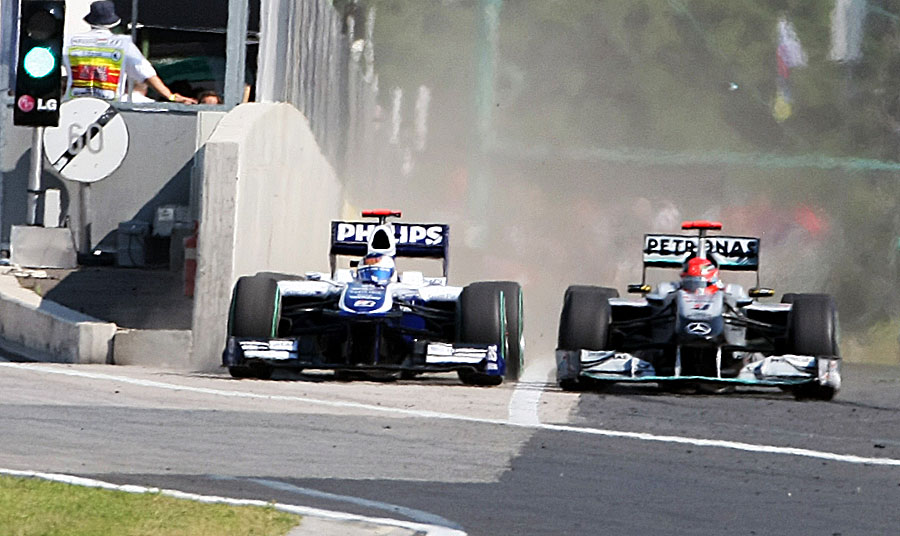 Rubens Barrichello squeezes past Michael Schumacher on Sunday
Michael at the time was clearly watching his mirrors like a hawk and squeezed his former helper towards the concrete retaining wall of the pit lane.
Millions watched as Rubens came within five centimetres of an almighty accident, not only was the wall there, and very solid, but had anyone been exiting the pits at the time the consequences would have been unthinkable.
Michael is a winner, and will go to any length to do so. However with all his ‘chops’ at starts and questionable collisions with championship contenders in slow corners he had never put an opponent in such a life threatening situation before.
After he had calmed down, and the adrenaline had subsided, even he himself admitted that he had been wrong.
This season is putting an ever increasing black mark over his glittering career. While no single season can ruin a reputation that includes 91 victories - it will leave a bad taste in the mouth if he continues to drive this way.
He is obviously having problems with adjusting to the new car and tyres - but rather than turning to desperation when trying to keep a meagre position he should perhaps be trying to concentrate on his own driving.
The lack of testing will hit the hardest on someone used to a different F1 - one of high downforce and low mechanical grip - and he needs to be using every moment he has getting used to racing, rather than endangering those around him with stupid driving.
What we need to see is the Schumacher of old - the one we watched and wondered why he wouldn’t just go away because our guys couldn’t get close. The one you had to admire, even if you hated yourself for it.
What we don’t need is a maniac in a high powered open wheel sports car causing the sort of accident Chris van der Drift suffered at Brands Hatch this weekend.
I’d like to see him up front, giving people like Hamilton something to remember - a challenge, and the ability to say they raced against THE Michael Schumacher. At the moment all we’ve got is a frustrated middle aged man living out his crisis on track endangering others. It cannot go on too much longer.
Sunday, 11 October 2009
Who's killing the hydrogen fuel cell?
In 2006 Chris Paine asked Who Killed the Electric Car? Well never mind that, how about asking why is the electric car killing cleaner technology?
There are many ways to power a vehicle, the Internal Combustion Engine is the mainstay of the motor industry due to it's simplicity. Over the years other methods have been tried by governments wishing to create a new generation of military vehicle. They have even experimented with Nuclear powered cars but the enduring dream has been the electric car. Especially in these newly environmentally friendly times people want new methods of powering cars.
The government and environmental campaigners love the electric car. It looks great for a politician to be seen next to a car with 'zero emissions'. They're wonderful and clean, none of that nasty pollution out of the back of one of these. Of course what they never mention is where the electricity to power them comes from. They sound environmentally friendly so they must be the saviours of the world.
What they're not pointing out is where the electricity your little G-Wiz is currently sucking in comes from. It has to be generated somehow. In this and many countries most mains electricity comes from coal or gas fired power stations. An electric car can only really be 'clean' if governments would fully commit to Nuclear and Renewable energy sources but, of course, they won't.
Not only are all the G-Wiz's around London not reducing the amount of Carbon-Dioxide we produce drastically, they are unsafe. In 2007 the BBC's Top Gear magazine carried out an NCAP style test on one. Upon completion it took over half an hour to extricate the test dummy, which came out in three separate parts.
Last year Honda revealed it's FCX Clarity. A car that runs on a Hydrogen Fuel Cell. Hydrogen reactions have been known to man since long before Karl Benz even though to put an Internal Combustion Engine in an automobile. Fuel cells work by reacting Hydrogen and Oxygen in the same way that a battery works. However, in this case the chemicals involved are constantly flowing into the cell so it cannot 'die' like a battery. It's like having a power station on board your G-Wiz.The only difference to strapping a coal powered station to your car, other than weight, is that the only by product of this reaction is fresh water.
The clarity is not just some pipe dream of a concept car only to be released possibly in 20 years time. It has gone into circulation already. Last year Honda made it available for customers to lease in California, where a hydrogen network had been set up to provide fuel. Honda expects to rent out at least 200 over three years across the US and Japan.
Honda's work shows that the technology is not a flight of futuristic fancy, it's genuinely usable now. All that is needed is for governments to get behind research into a technology that is genuinely good for the environment rather than placating the environmental lobby with ultimately empty gestures.
Thursday, 10 September 2009
F1's sticky situation
"I confirm the meeting with Piquet on Sunday morning, but nothing like that was ever talked about." F. Briatore
"It's true, during the Sunday meeting with Piquet the issue of deliberately causing a SC deployment came up, but it was proposed by Piquet himself" P. Symonds
It's a simple matter for the FIA now of who to believe. Nelson Piquet Jr, who is accusing the Renault F1 team of colluding with him to cause a crash at the right point in the race to hand the win to Fernando Alonso. Flavio Briatore who admits a meeting took place but claims the issue was never discussed (or did last time anyone may have heard from him). Pat Symonds who claims the issue was brought up but only by the driver himself and was rejected by the team.
If Flavio is to be believed then Renault are the victims of a bitter former driver looking for payback. This seems the most logical choice initially, but then you remember than Nelson Piquet (the father of the driver in question and three time world champion) was the man who made the initial claim, not his son. Nelson is not a man to stake his reputation on a lie. Then we have the Symonds version. To believe this we must also believe that a team who new that a deliberate crash was in their drivers mind then saw him crash and thought nothing of it. The whole right rear corner of Nelsinho's car was destroyed. Not a cheap matter by any stretch of the imagination. So why was he not sacked if the team had reason to believe he had willfully destroyed one of their cars. Not only that but should it come out that Piquet had carried out his plan, say nearly a year later, the teams name would be dragged through the mud and their reputation left in tatters.

No matter what the result of the investigation into the events surrounding Fernando Alonso's surprise win at Singapore last September the implications for the sport have to be massive. This isn't just a crash changing the outcome of a race, this is a team conspiring internally to endanger the lives not only of it's own drivers but the rest of the drivers on the grid. This is a team attempting to artificially engineer a situation in which their driver would win a race with little effort.
The name of F1 has already been dragged through the mud enough over the last few years. The acrimony of Fernando Alonso's time at McLaren. The 'spygate' scandal involving McLaren (again) having a dossier on Ferrari's car in their possession. Renault being accused of the same crime involving McLaren data. Max Mosley's penchant for S&M. The threatened FOTA breakaway leading to the potential ousting of Mosley from his position at the head of the FIA, the sports governing body. The lying scandal that hit the Australian Grand Prix when McLaren's Davey Ryan and Lewis Hamilton lied to the stewards to gain a position after the race. The penalty given to Lewis Hamilton, rightly or wrongly, at Spa in 2008. Over the last few years F1 has become a laughing stock, riddled with scandal at every turn. Now, just as the sport seems finally in harmony, we are hit by what could be perceived as the worst scandal yet. Anybody who thought the worst was over should shove their head back into the sand again for a while.

The perception outside of the F1 community and it's fans is already that it's a rich mans play world. The fact that they all appear to be dishonest just goes further to disillusioning any 'floating fans' who might have felt alienated by the events they've seen unfold. The 'crashgate' saga (as it stereotypically must be called now) brings a huge amount of media attention back onto F1, this attention will for a while boost TV audiences baying for a scandal. In the long run people are going to look at F1 and think 'Why should I watch that? Their all dishonest anyway'. Personally I pray that it didn't happen, I hope that despite the evidence mounting against Renault it comes out that Nelson Piquet was just a bitter father who'd seen his son rejected and an investment of millions come to nought. F1 will survive this scandal, but it will take a long time to recover the confidence of it's audience.
"It's true, during the Sunday meeting with Piquet the issue of deliberately causing a SC deployment came up, but it was proposed by Piquet himself" P. Symonds
It's a simple matter for the FIA now of who to believe. Nelson Piquet Jr, who is accusing the Renault F1 team of colluding with him to cause a crash at the right point in the race to hand the win to Fernando Alonso. Flavio Briatore who admits a meeting took place but claims the issue was never discussed (or did last time anyone may have heard from him). Pat Symonds who claims the issue was brought up but only by the driver himself and was rejected by the team.
If Flavio is to be believed then Renault are the victims of a bitter former driver looking for payback. This seems the most logical choice initially, but then you remember than Nelson Piquet (the father of the driver in question and three time world champion) was the man who made the initial claim, not his son. Nelson is not a man to stake his reputation on a lie. Then we have the Symonds version. To believe this we must also believe that a team who new that a deliberate crash was in their drivers mind then saw him crash and thought nothing of it. The whole right rear corner of Nelsinho's car was destroyed. Not a cheap matter by any stretch of the imagination. So why was he not sacked if the team had reason to believe he had willfully destroyed one of their cars. Not only that but should it come out that Piquet had carried out his plan, say nearly a year later, the teams name would be dragged through the mud and their reputation left in tatters.
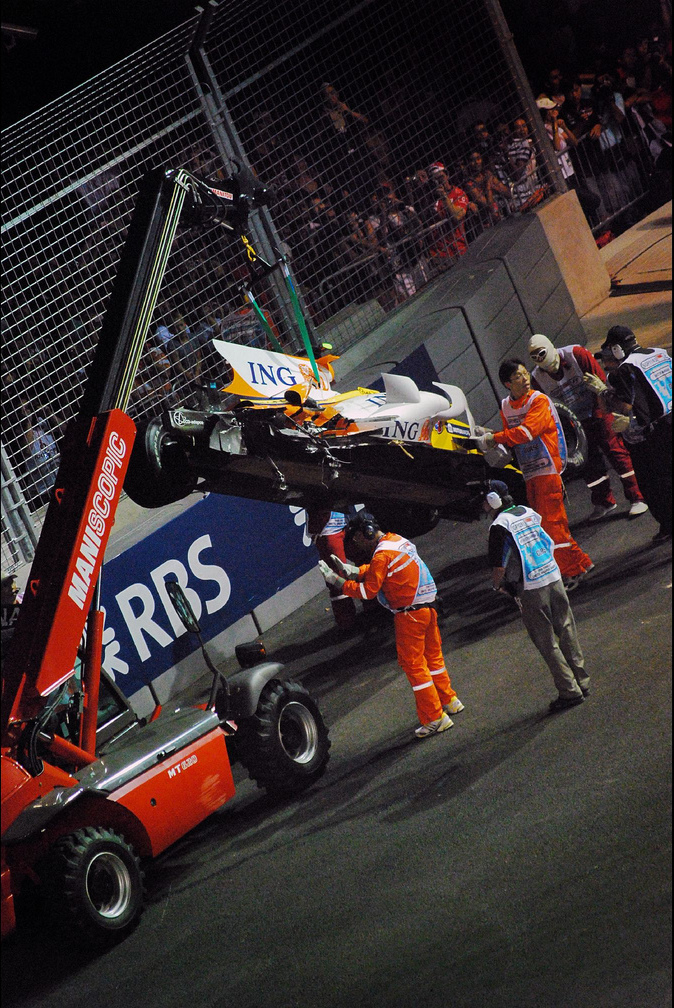
No matter what the result of the investigation into the events surrounding Fernando Alonso's surprise win at Singapore last September the implications for the sport have to be massive. This isn't just a crash changing the outcome of a race, this is a team conspiring internally to endanger the lives not only of it's own drivers but the rest of the drivers on the grid. This is a team attempting to artificially engineer a situation in which their driver would win a race with little effort.
The name of F1 has already been dragged through the mud enough over the last few years. The acrimony of Fernando Alonso's time at McLaren. The 'spygate' scandal involving McLaren (again) having a dossier on Ferrari's car in their possession. Renault being accused of the same crime involving McLaren data. Max Mosley's penchant for S&M. The threatened FOTA breakaway leading to the potential ousting of Mosley from his position at the head of the FIA, the sports governing body. The lying scandal that hit the Australian Grand Prix when McLaren's Davey Ryan and Lewis Hamilton lied to the stewards to gain a position after the race. The penalty given to Lewis Hamilton, rightly or wrongly, at Spa in 2008. Over the last few years F1 has become a laughing stock, riddled with scandal at every turn. Now, just as the sport seems finally in harmony, we are hit by what could be perceived as the worst scandal yet. Anybody who thought the worst was over should shove their head back into the sand again for a while.

The perception outside of the F1 community and it's fans is already that it's a rich mans play world. The fact that they all appear to be dishonest just goes further to disillusioning any 'floating fans' who might have felt alienated by the events they've seen unfold. The 'crashgate' saga (as it stereotypically must be called now) brings a huge amount of media attention back onto F1, this attention will for a while boost TV audiences baying for a scandal. In the long run people are going to look at F1 and think 'Why should I watch that? Their all dishonest anyway'. Personally I pray that it didn't happen, I hope that despite the evidence mounting against Renault it comes out that Nelson Piquet was just a bitter father who'd seen his son rejected and an investment of millions come to nought. F1 will survive this scandal, but it will take a long time to recover the confidence of it's audience.
Sunday, 6 September 2009
The stream that changed F1
It's a small stream running through the Liege region of Belgium. In the whole of it's 15km length the Eau Rouge stream has no remarkable features and is of no significance in the geological world. Yet utter those two French words to anyone who's ever seen a motor race and they will evoke feelings that even words like Senna struggle to produce. Below is a picture of the stream to demonstrate just unremarkable it is:
 Picturesque? Yes. A nice place to be? Yes. One of the most famous names in motorsports? You bet.
Of course it's not the stream itself that brings the fame, but the landscape that it has carved through the woodlands that make the name famous. The area around it is a valley carved out of the mountainsides over thousands of years. Allowing for a wooded area to be transformed into possibly the most stunning location an F1 car has driven round for many a year. Of course given that there are numerous towns and villages in the area there had to be roads built to get about. These criss-crossed the area in the early part of the 20th century forming an almost perfect triangle between the towns of Francorchamps, Malmedy and Stavelot, so, humans being humans, people had to have a race. The circuit that was created was one of the fastest and most dangerous in the world. However, all the track did around the annoying stream it had to cross was loop round in a slow section called Ancienne Douane. However in 1939 the organisers decided to use a short cut that swept up the valley giving the circuit a much better flow. I doubt they realised they icon they had just created.
The corner, existing now in the same form it has since 1939, is the first point after the start finish straight at which the circuit crosses the stream. It is approached on a steep decline down the side of the valley from the La Source hairpin (in itself an evocative name). The cars launch over the stream into a massive compression as they flick to the left, bottoming out as they are launched up the other side of the valley at 180mph. They then navigate the ferocious Radillon corner (strictly speaking 'Eau Rouge' is only the left flick at the bottom) arching back to the right before hurling themselves to the left over the blind summit.

The Main reason for the awe inspired by the group of corners is simply the gradient. It is not only the steepest gradient in F1 but comes after a descent that would seem steep were it not for it's position. The combination of the two creates forces not seen elsewhere in F1. The car is pulled downwards by gravity whilst being forced upwards by the gradient. The driver is flung to the right, left and then back to the right again whilst undergoing all this. The cars 'bottom out' as they go beyond the limit of their suspension travel and the whole chassis contorts under the enormous loads its being put under. The forces involved are mind boggling. Nowadays the corner is easily flat out in an F1 car, but the knowledge of this doesn't fit with the sounds you hear as the cars tackle it. Purely due to the gradient the cars decelerate up the slope. That's more than 800 bhp being reigned in purely by gravity. Astonishing.
 F1's stars of tomorrow tackle Radillon
The impact that the Eau Rouge section has on people is massive. Walking round the circuit for the first time people immediately plan when they are going to see Eau Rouge. If you walk from the Les Combes entrances clockwise round the circuit your first glimpse of the area is from the Bus Stop area. It's not of the track, just a view of the tree line across the valley taking a sudden, noticeable dip. People who come to this area for the first time point across the valley. No matter where they're from it sets the pulse racing. The problem with writing about Eau Rouge is that words and pictures can never, ever, do it justice. Not one bit. The gradient is steeper than any picture shows it to be. The speeds cars go through there is just mind boggling and the blindness (if that's a word) of the crest of Radillon is unbelievable. Don't believe me? How about Fernando Alonso?:
Meanwhile below all this, the stream keeps on its gentle way through the mountains, none the wiser of it's lasting impact.
 Picturesque? Yes. A nice place to be? Yes. One of the most famous names in motorsports? You bet.
Of course it's not the stream itself that brings the fame, but the landscape that it has carved through the woodlands that make the name famous. The area around it is a valley carved out of the mountainsides over thousands of years. Allowing for a wooded area to be transformed into possibly the most stunning location an F1 car has driven round for many a year. Of course given that there are numerous towns and villages in the area there had to be roads built to get about. These criss-crossed the area in the early part of the 20th century forming an almost perfect triangle between the towns of Francorchamps, Malmedy and Stavelot, so, humans being humans, people had to have a race. The circuit that was created was one of the fastest and most dangerous in the world. However, all the track did around the annoying stream it had to cross was loop round in a slow section called Ancienne Douane. However in 1939 the organisers decided to use a short cut that swept up the valley giving the circuit a much better flow. I doubt they realised they icon they had just created.
The corner, existing now in the same form it has since 1939, is the first point after the start finish straight at which the circuit crosses the stream. It is approached on a steep decline down the side of the valley from the La Source hairpin (in itself an evocative name). The cars launch over the stream into a massive compression as they flick to the left, bottoming out as they are launched up the other side of the valley at 180mph. They then navigate the ferocious Radillon corner (strictly speaking 'Eau Rouge' is only the left flick at the bottom) arching back to the right before hurling themselves to the left over the blind summit.

The Main reason for the awe inspired by the group of corners is simply the gradient. It is not only the steepest gradient in F1 but comes after a descent that would seem steep were it not for it's position. The combination of the two creates forces not seen elsewhere in F1. The car is pulled downwards by gravity whilst being forced upwards by the gradient. The driver is flung to the right, left and then back to the right again whilst undergoing all this. The cars 'bottom out' as they go beyond the limit of their suspension travel and the whole chassis contorts under the enormous loads its being put under. The forces involved are mind boggling. Nowadays the corner is easily flat out in an F1 car, but the knowledge of this doesn't fit with the sounds you hear as the cars tackle it. Purely due to the gradient the cars decelerate up the slope. That's more than 800 bhp being reigned in purely by gravity. Astonishing.
 F1's stars of tomorrow tackle Radillon
The impact that the Eau Rouge section has on people is massive. Walking round the circuit for the first time people immediately plan when they are going to see Eau Rouge. If you walk from the Les Combes entrances clockwise round the circuit your first glimpse of the area is from the Bus Stop area. It's not of the track, just a view of the tree line across the valley taking a sudden, noticeable dip. People who come to this area for the first time point across the valley. No matter where they're from it sets the pulse racing. The problem with writing about Eau Rouge is that words and pictures can never, ever, do it justice. Not one bit. The gradient is steeper than any picture shows it to be. The speeds cars go through there is just mind boggling and the blindness (if that's a word) of the crest of Radillon is unbelievable. Don't believe me? How about Fernando Alonso?:
"You come into the corner downhill, have a sudden change [of direction] at the bottom and then go very steep uphill. From the cockpit, you cannot see the exit and as you come over the crest, you don't know where you will land. It is a crucial corner for the timed lap, and also in the race, because you have a long uphill straight afterwards where you can lose a lot of time if you make a mistake. But it is also an important corner for the driver's feeling. It makes a special impression every lap, because you also have a compression in your body as you go through the bottom of the corner. It is very strange - but good fun as well."
Meanwhile below all this, the stream keeps on its gentle way through the mountains, none the wiser of it's lasting impact.
Thursday, 3 September 2009
So that was Spa? To say it lived up to expectations would not do it justice at all. The place is something else from the moment you arrive. When on a coach you're sent off on what is deemed to be a shorter route... through a tiny village on a hillside. The village it turns out is also the coach car park. This after you've spent at least an hour going down a single track lane through the woods from the main motorway.
As you walk up to the entrance all you can hear is the cars, not because of proximity but simply because of the location of the track. It's set right on the hillsides around the small stream of Eau Rouge, a name that almost dwarfs that of the track with it's significance. The hillsides steep gradient amplifies the already mesmerising sound, filling the adjacent valley and heightening the sense of excitement as you approach. If you head to your left as you approach your sense of excitement will only be heightened as you find your way blocked by orange jacketed officialdom unless you posses a gold ticket. The tunnel under the track is the only way for you to go, so you can still hear the cars but again your view is blocked, so under you go, into a small area surrounded by fellow fans all rushing to get toward the viewing areas. Then, suddenly, there it is. You're stood looking down on the cars below you as your first glimpse is from about 30 feet above the track. No other track I have been to puts you in this position. You're stood on the edge of a cliff looking down on the track, with people in front of you who have been there for hours. It's not just a track, newer tracks like Valencia the week before do not offer this kind of experience. This is before you've even approached the well known areas, this is an un-named corner between Rivage and Pouhon. That's the brilliance of Spa. Everywhere has something to offer, I didn't find myself at a single spot where there wasn't either an amazing view of the track or something unique.
 Perched on the edge of the path you get a great view of the cars
So the First impressions are good, but that's nothing yet. Wander a little further and your at what the drivers say is one of the most difficult corners in the world; the double apexed Pouhon. A corner approached by both cars and fans down a steep hill, it has a massive spectator bank to the right and trees obscuring the rest of the corner to the left. The cars dive into a cauldron cocooning them between fans and failure, desperately attempting to judge the one downshift that will be the only thing that slows them through the corner. A couple of seconds late and they'll hit the corner too fast, to early and the electronics on the gearbox override the order to change down. Yet again the setting of the circuit causes the atmosphere to be electric. People are perched on the top of the bank in chairs 4 deep but at the back you can still see perfectly. Meanwhile thousands more are sat on the steep bank, often dug in with mini shovels. Behind them Sausages and Hamburgers are being served alonside Waffles and Beer. The whole atmosphere is intoxicating. You can hear the cars straining against their gearboxes during the crucial change whilst turning and you feel a part of the whole experience.
 Nico Rosberg Attempts to get Pouhon right
You can spectate on almost every part of the track with a general admission pass, in the next part of this post I'll talk about the Qualifying experience pressed up against the fence on the entrance to the bus stop...
As you walk up to the entrance all you can hear is the cars, not because of proximity but simply because of the location of the track. It's set right on the hillsides around the small stream of Eau Rouge, a name that almost dwarfs that of the track with it's significance. The hillsides steep gradient amplifies the already mesmerising sound, filling the adjacent valley and heightening the sense of excitement as you approach. If you head to your left as you approach your sense of excitement will only be heightened as you find your way blocked by orange jacketed officialdom unless you posses a gold ticket. The tunnel under the track is the only way for you to go, so you can still hear the cars but again your view is blocked, so under you go, into a small area surrounded by fellow fans all rushing to get toward the viewing areas. Then, suddenly, there it is. You're stood looking down on the cars below you as your first glimpse is from about 30 feet above the track. No other track I have been to puts you in this position. You're stood on the edge of a cliff looking down on the track, with people in front of you who have been there for hours. It's not just a track, newer tracks like Valencia the week before do not offer this kind of experience. This is before you've even approached the well known areas, this is an un-named corner between Rivage and Pouhon. That's the brilliance of Spa. Everywhere has something to offer, I didn't find myself at a single spot where there wasn't either an amazing view of the track or something unique.
 Perched on the edge of the path you get a great view of the cars
So the First impressions are good, but that's nothing yet. Wander a little further and your at what the drivers say is one of the most difficult corners in the world; the double apexed Pouhon. A corner approached by both cars and fans down a steep hill, it has a massive spectator bank to the right and trees obscuring the rest of the corner to the left. The cars dive into a cauldron cocooning them between fans and failure, desperately attempting to judge the one downshift that will be the only thing that slows them through the corner. A couple of seconds late and they'll hit the corner too fast, to early and the electronics on the gearbox override the order to change down. Yet again the setting of the circuit causes the atmosphere to be electric. People are perched on the top of the bank in chairs 4 deep but at the back you can still see perfectly. Meanwhile thousands more are sat on the steep bank, often dug in with mini shovels. Behind them Sausages and Hamburgers are being served alonside Waffles and Beer. The whole atmosphere is intoxicating. You can hear the cars straining against their gearboxes during the crucial change whilst turning and you feel a part of the whole experience.
 Nico Rosberg Attempts to get Pouhon right
 You can spectate on almost every part of the track with a general admission pass, in the next part of this post I'll talk about the Qualifying experience pressed up against the fence on the entrance to the bus stop...
Tuesday, 25 August 2009
My kind of Spa
It's magic, it really is. I haven't even got within a day of setting off for my first visit and I'm already excited. What do you expect? Since I was about 11 I've wanted to go to Spa to witness the Belgian GP. It's amazing that a small country in the north of Europe can have produced such an evocative race track. Those who have only witnessed motor racing on TV have never quite experienced the full reality of what makes it wonderful. Spa is one of those places where that wonder is magnified. Firstly at any race there's the sight, a TV camera does not do anything justice. The direction changes and speeds have to be seen in real life when it comes to the higher end of the spectrum. For example a Le Mans Prototype looks like it's trundling along like you or I down the A605 when on TV. Stand next to the Hanger straight and it's nothing like it, 170mph looks amazing, it just does. That speed isn't there on it's own remember, each car is hurtling past you on its way round but a silent race would not be the same. The sound and feeling of a car going past is something else. The sound of an F1 car as it screams past is diluted on TV, it's not a painfully loud sound (In fact the M25 is harder to listen to), but it is an awesome sound. It fills the air around you channeled by whatever fencing may be around the track, echoing of surrounding buildings. The rumble of the sound waves is felt as well. In the pit of your stomach the sound builds into a vibration that digs into you, ensuring that that sound is not just all around you. That sound is entering you. You become a part of what is going past in a way that nothing else can produce. All the while your eyes are being assaulted by the cars going past and your nose is picking up the scent of motorsports. The smell of a race meeting can't be found by a normal road. It's something far more wonderful. A heady mix of race fuel, oil, tyre smoke and whatever is around you. If you don't like it then don't bother with motorsports. It may only be a smell, but that smell is as big a part of your experience as what you are seeing. This is all an almost indescribable effect, each of your senses is being stimulated. No other spectator sport does that for you, you certainly don't get it sat in front of the TV. All of this happens at every race track, but some are more special than others. Spa-Francorchamps is as much a part of F1 as Ferrari, McLaren and Williams. It's been there since the 20's in it's various forms. The modern day circuit, though undoubtedly one of the best in the world, is still but a shadow of it's former self. Neutered for safety it still has corners that strike fear and excitement into the heart of any racing drivers.
 The modern Spa Circuit
Originally set between the Belgian villages of Francorchamps, Malmedy and Stavelot the circuit was a fearsome 15km monster snaking it's way through the Belgian forests. Before it was reduced for safety reasons it contained the fearsome Mastah kink, an incredible high speed left right kink that was crucial to the lap. It was this section that lead to the old circtuits downfall. One particularly gruesome story from the 1972 24hrs race gives an idea of why the circuit had to be changed: During a pit stop during the night HJ Stuck shouted to his co-driver Jochen Mass to tell him to 'watch out for body parts at the Mastah kink'. Mass arrived upon the schene expecting to find bits of car, but instead discovered it was in fact bits of a Marshall. The new circuit hasn't lost much of it's ancestors qualities though, barely 2 years after F1 returned to the track it claimed the life of Stephan Bellof in a sportscar crash. Eau Rouge, Blanchiment and La Source are the only parts remaining of the old circuit. Eau Rouge is perhaps the most famous corner in the world. A high speed left-right-left up a steep incline over a blind crest it is one of the most challenging corners for any driver to master. Until 2000 it was still possible to drive a large portion of the track as public roads. If you really need more proof that this is one of the best circuits around then perhaps Micheal Schumacher can persuade you:
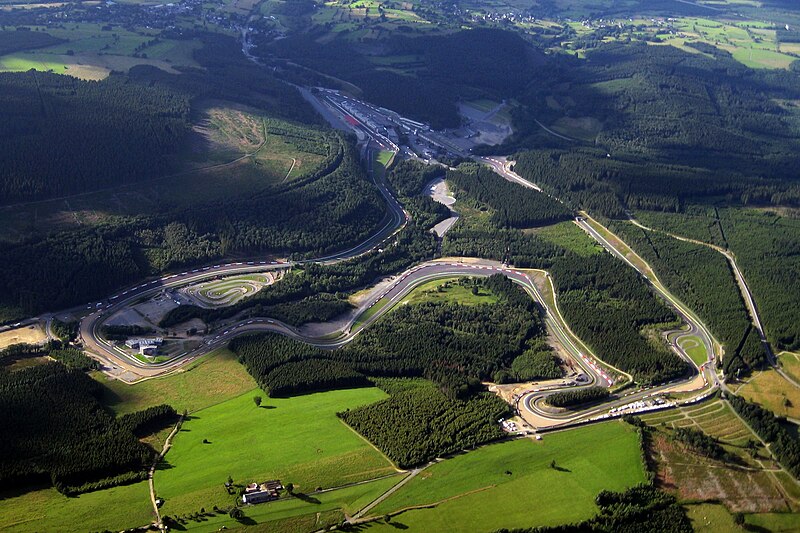 The modern Spa Circuit
Originally set between the Belgian villages of Francorchamps, Malmedy and Stavelot the circuit was a fearsome 15km monster snaking it's way through the Belgian forests. Before it was reduced for safety reasons it contained the fearsome Mastah kink, an incredible high speed left right kink that was crucial to the lap. It was this section that lead to the old circtuits downfall. One particularly gruesome story from the 1972 24hrs race gives an idea of why the circuit had to be changed: During a pit stop during the night HJ Stuck shouted to his co-driver Jochen Mass to tell him to 'watch out for body parts at the Mastah kink'. Mass arrived upon the schene expecting to find bits of car, but instead discovered it was in fact bits of a Marshall. The new circuit hasn't lost much of it's ancestors qualities though, barely 2 years after F1 returned to the track it claimed the life of Stephan Bellof in a sportscar crash. Eau Rouge, Blanchiment and La Source are the only parts remaining of the old circuit. Eau Rouge is perhaps the most famous corner in the world. A high speed left-right-left up a steep incline over a blind crest it is one of the most challenging corners for any driver to master. Until 2000 it was still possible to drive a large portion of the track as public roads. If you really need more proof that this is one of the best circuits around then perhaps Micheal Schumacher can persuade you:
"It is without doubt the best circuit in the world," Schumacher says. "The kind of atmosphere you get at Spa is something akin to the old Nurburgring. It is the only place which still has this quality and atmosphere. Eau Rouge is really the most tremendous corner. It is like flying downhill and seeing a big mountain in front of you. You get the feeling that you are driving into the road and then you go up and it is a sensation which is probably the best you can experience and the most satisfaction you can have as a racing driver."
Spa is motorsports at it's best, I hope that I can convey at least some of what makes it so fantastic over the next week.
Subscribe to:
Posts (Atom)